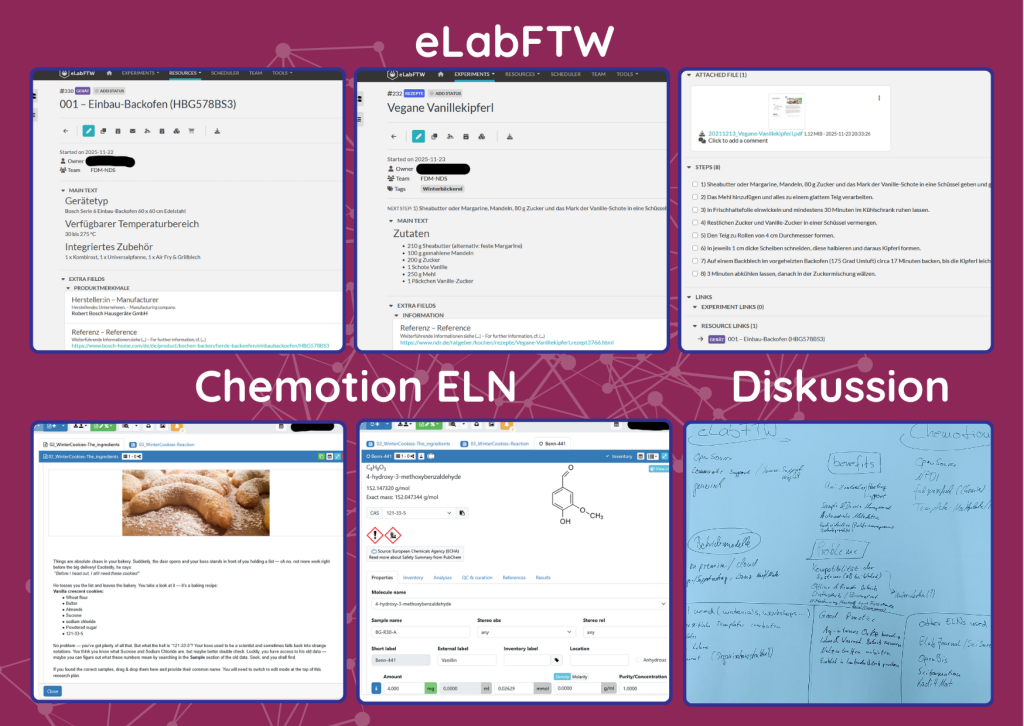
The workshop “Dynamic ELN Workshop – Hands-on, playful and insightful!” consisted of four stations, between which participants were free to switch. The aim of the workshop was, on the one hand, to demonstrate different electronic lab notebooks (ELNs) in a hands-on manner without giving a long theoretical introduction and, on the other hand, to discuss needs, wishes, actual and target situations. The four stations were:
- eLabFTW,
- Automation with eLabFTW,
- Chemotion ELN,
- General discussions on electronic lab notebooks in Lower Saxony.
Station 1 – eLabFTW
To demonstrate the versatile possibilities of eLabFTW, participants were given the task of documenting their favorite cookie recipe (including the necessary utensils) in the electronic lab book. The ELN had been preloaded with sample recipes and equipment to make it easy for participants to get started and learn about the interaction and linking of experiments and resources. By applying steps based on the recipe analogy, participants also had the opportunity to explore more advanced functions of eLabFTW. Aljoscha Erlebach (MHH) was on hand to assist with implementation and answer any questions about the ELN.
Station 2 – Automation with eLabFTW
Those who had familiarized themselves with the basics of eLabFTW at Station 1 (or already had prior knowledge) were then able to try out the automatic creation of a lab book entry from a Python program using an example from Hanno Dierke (PTB). A small sample GUI programmed in Python was used for this purpose. In addition to highlighting the components executed in the program itself, the final appearance of an entry in the ELN was examined in detail and possible applications were discussed.
Station 3 – Chemotion ELN
At Station 3, visitors had the opportunity to learn about the subject-specific electronic laboratory notebook Chemotion ELN (for chemistry and chemistry-related research) by completing small puzzles. This allowed even non-chemists to take a look at the software and learn more about its basic functions, especially in comparison to the generic eLabFTW. Using identifiers, participants had to find suitable substances, link them, and add information. Benjamin Golub-Overbeck (TU Braunschweig) was on hand to answer questions and provide assistance, and demonstrated advanced functions of the ELN to interested visitors.
Station 4 – General discussions on ELNs in Lower Saxony
In addition to the insights gained at the other stations, this station focused on a general exchange on ELNs in Lower Saxony, the advantages and disadvantages of individual solutions, and a collection of questions and challenges. Topics such as data transfer between different ELNs, the desire for assistance in developing subject-specific templates, and the integration of ELNs into teaching (internships) were raised. The valuable discussions and questions will be explored in greater depth and solutions developed as part of the FDM-NDS Pillar 3 project eLabFTW@FDM-NDS. The discussion and collection of questions were led by Janna Neumann (TIB).
Summary
The workshop made it clear that interest in the use of electronic lab books is growing and that there are still many needs, unanswered questions, and challenges for both administrators and users. The open and dynamic format of the different stations proved to be successful, so that similar workshop formats are being considered for the future. Special thanks also go to Florian Strauß (TU Clausthal) and Jessica Hiller (TU Clausthal), who provided active support in preparing the workshop, as well as to the Deltablot team for providing a training instance for eLabFTW.